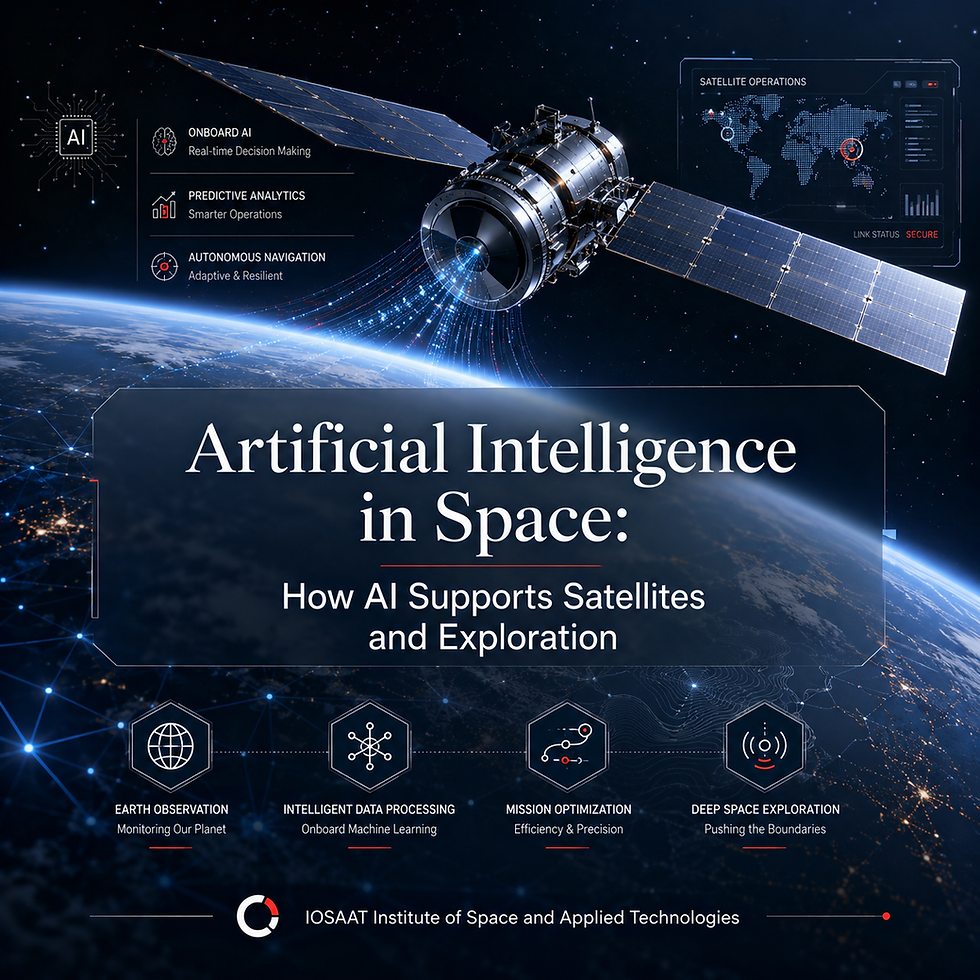
Artificial Intelligence in Space: How AI Supports Satellites and Exploration
Artificial intelligence is becoming an important part of modern space technology. In simple terms, AI helps machines learn from data, recognize patterns, and support decisions with less need for constant human control. In space, where distance, time, and technical limits can make direct control difficult, AI can help satellites and exploration systems work more efficiently.
For the Institute of Space and Applied Technologies IOSAAT, in cooperation with SIU Swiss International University and VBNN, this topic is important because space technology is no longer only about rockets and satellites. It is also about data, automation, smart systems, and responsible innovation.
AI and Satellite Operations
Satellites collect large amounts of information every day. This information may come from Earth observation, communication systems, navigation signals, weather monitoring, or scientific instruments. AI can help process this data faster and make it more useful.
For example, AI can support satellites in identifying patterns in images, detecting changes on Earth’s surface, monitoring environmental conditions, or helping operators understand technical signals from the satellite itself. Instead of waiting for every detail to be reviewed manually, AI systems can highlight what may need attention.
This does not mean that humans are replaced. In serious space operations, human expertise remains essential. AI supports experts by reducing repetitive work, improving speed, and helping teams focus on important decisions.
Smarter Earth Observation
One of the strongest uses of AI in space is Earth observation. Satellites can take images of forests, oceans, cities, farms, deserts, and ice regions. These images can help people study climate, land use, agriculture, natural disasters, and infrastructure.
AI can help compare images over time and detect changes. It can support early warning systems, assist in mapping damaged areas after storms or earthquakes, and help researchers understand environmental trends. This makes satellite data more practical for governments, businesses, scientists, and communities.
When used responsibly, AI-supported satellite analysis can improve planning, safety, and sustainability.
AI in Space Exploration
Space exploration also benefits from artificial intelligence. When a spacecraft is far from Earth, communication can take time. A machine operating on another planet or in deep space may need to make certain basic decisions without waiting for immediate instructions.
AI can help robotic systems navigate, avoid obstacles, manage energy, and select useful data for transmission. It can also assist in analyzing scientific information collected by instruments. This is especially useful when missions operate in unknown or difficult environments.
AI helps exploration become more adaptive. It allows space systems to respond better to changing conditions while still following mission rules and human guidance.
Supporting Satellite Health and Maintenance
Satellites must operate in difficult conditions. They face radiation, temperature changes, limited repair options, and long mission periods. AI can help monitor satellite health by analyzing technical data from onboard systems.
If unusual behavior appears, AI can help detect it early. This can support preventive maintenance, reduce risks, and help mission teams act before a small issue becomes a serious problem. In the future, AI may also help satellites manage some routine adjustments automatically.
Why AI Literacy Matters in Space Education
As space technology becomes more connected with digital systems, students and professionals need to understand both space science and artificial intelligence. They do not need to become experts in every technical field, but they should understand how AI works, where it can help, and where human responsibility remains necessary.
At the Institute of Space and Applied Technologies IOSAAT, this subject fits naturally within applied space education. It connects satellite technology, data analysis, robotics, communication, ethics, and future exploration. It also shows how space education can prepare learners for practical and interdisciplinary challenges.
A Responsible Future
AI in space should be developed with care. Accuracy, transparency, cybersecurity, human supervision, and ethical use of data are all important. Space systems affect communication, environment, safety, and global knowledge, so intelligent technologies must be used responsibly.
Artificial intelligence is not a magic solution, but it is a powerful tool. When combined with strong education, scientific thinking, and responsible management, AI can help satellites and exploration systems become smarter, safer, and more useful for humanity.


Comments